
Before listening to the whole album, let's begin with the title.
Across ROSALÍA's album LUX, "Reliquia" is a song with real structural significance. This is the point where her musical world truly begins to come into focus. It transforms the split experience of the modern subject in a fluid world into a form of self-narration that is almost sacred.
The word "reliquia" itself carries a strong religious charge. In Spanish, it can refer to a relic: bodily remains left behind by a saint after death, or related objects preserved, venerated, distributed, and contemplated.
So from the moment it is named, the song already enters a more complex symbolic system: can those parts of the self that time, space, and relationships keep stripping away be preserved in the form of "relics," and thereby acquire meaning?
When we talk about brokenness, about division, the first thing that comes to my mind is actually the Dionysian. This song has a substantial connection to Nietzsche. Let's keep listening.
#Intro
The intro opens with violin arpeggios that carry a Baroque flavor, yet it does not fully follow the clear and orderly orchestration logic of the classical period. It is not a single well-defined instrument playing a single well-defined line. Instead, several violins in different, slightly scattered parts take the lead, with spiccato cello gestures as accents, holding up the harmony underneath.
It reminded me of one particular work: Max Richter's recomposition of Vivaldi's The Four Seasons.
You can hear that they are doing something similar: taking a canonical work, or a canonical form, and deconstructing and reassembling it within a postmodern context. Right here, ROSALÍA already establishes "deconstruction" as one of the song's key ideas, and gives us an early musical, intuitive sense of what it means for relics to be scattered across the world.
#ACT I
#Verse 1
Yo que perdí mis manos en Jerez y mis ojos en Roma1
I lost my hands in Jerez and my eyes in Rome
Crecí y el descaro lo aprendí por ahí por Barcelona
I grew up, and that fearless brazenness was something I learned somewhere around Barcelona
Perdí mi lengua en París, mi tiempo en LA2
I lost my language in Paris, and my time in LA
Los heels en Milán, la sonrisa en UK
I left my heels in Milan, and my smile in the UK
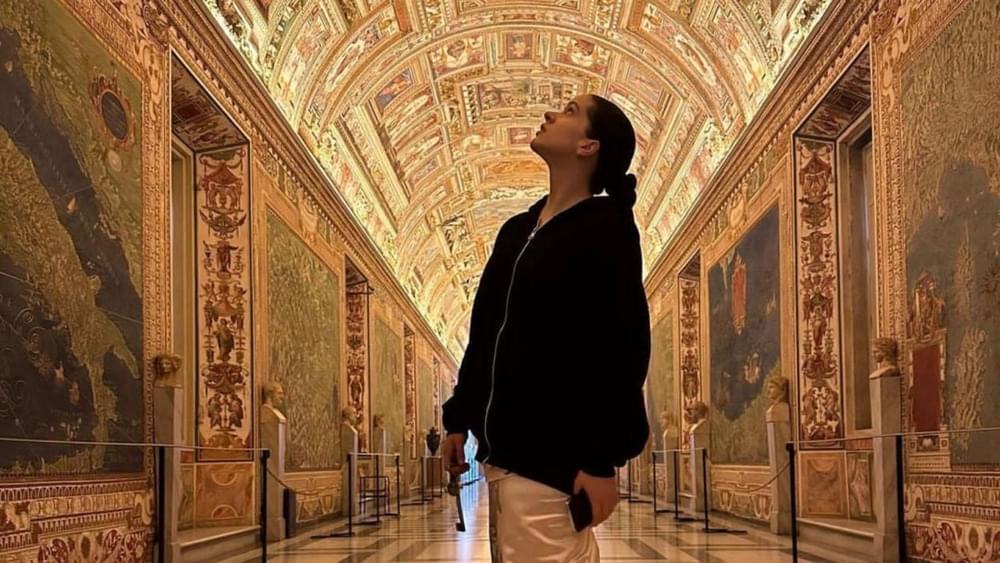
Lyrically, "Reliquia" opens with a nonlinear mode of narration. The lyrics are not telling us "where I have been," but "what I left behind where." Just like the string parts in the intro, already broken apart from each other, the "I" arrives onstage in a decomposed state: hands left in Jerez, eyes in Rome, language in Paris, time in Los Angeles, smile and style left behind in other cities.
It redefines the meaning of travel. It is not presenting a worldly, fully formed self. On the contrary, it emphasizes this: every journey takes away a part that once belonged to me.
As our bodies move through the world, crossing cities does not make us more whole. It breaks us apart, little by little. Here the song's deepest structure is already in place: the self is not a stable presence, but something made up of those parts that remain all over the world even after they have been lost.
By this point, you can already feel something distinctly Nietzschean. The dissolution of individual boundaries here resonates strongly with the Dionysian spirit. My body shatters into relics and scatters across the world, which means the subject is no longer a self-sufficient, closed, unified individual. From Nietzsche's perspective, this is already close to the first step of the Dionysian: the principle of individuation begins to loosen.
Musically, the song keeps reinforcing this nonlinear, fragmented feeling. ROSALÍA sings somewhere between narration and chant, and you can hear the stress pattern of the lyrics constantly shifting, so the list-like writing never feels too mechanical.
You can even count along to 1 2 3 4 yourself and notice that not every line begins at the same point in the bar. In that sense it also connects with the first track. Compared with the freer pulse of the opening song, "Reliquia" moves into 4/4, a stable meter, but it still uses pauses, blank space, and suspension to create a sufficiently fractured instability, along with a natural feeling that is never fully locked to the beat.
But this brokenness is not floating in midair, nor does it exist by itself. Beneath the accompaniment you can hear piano block chords, along with specially treated vocal chanting, placing these fragments inside a space that is solemn and spacious enough for them to appear like relics on display.
That choice is crucial, because it means the cities in the lyrics do not function merely as place names. They become echoing spatial nodes.
#Chorus
Pero mi corazón nunca ha sido mío, yo siempre lo doy, oh
But my heart has never really been mine; I always give it away, oh
Coge un trozo de mí, quédatelo pa' cuando no esté
Take a little piece of me, keep it with you for when I'm gone
Seré tu reliquia
I will become your relic, your sacred remainder
The final note before the chorus finally clicks into alignment. That tells us the chorus completes the song's most important turn of meaning: loss is no longer merely absence. It becomes preservation.
Look at the lyrics. Here the emotional logic behind the song is laid bare: her heart has never truly belonged to herself, because she is always giving it away. The point is not simply "devotion," but that "the heart itself is not mine." In other words, the division we heard in the verse is not accidental. It is inevitable. The core of the subject was never closed or privately owned to begin with; it was always destined to enter into relation with others.
The second line, "Coge un trozo de mí," is especially crucial. It turns abstract emotion into a concrete action: take a piece of me. At this point the religious meaning of Reliquia truly begins to emerge.
If the verse was only the prelude to a vast religious ritual, then the chorus becomes that ritual's real climax, and also the most conceptually powerful part of the song. We need to look back at the verb used in the verse: perdí, I lost. But in the last line of the chorus, it shifts into Seré tu reliquia, I will become. It does not write loss as pure lack. Instead, it completes a change of meaning: the part that is taken away becomes, precisely for that reason, the part that remains.
From here onward, the parts lost from her body undergo a kind of baptism. Only then do they fully accept the name "Reliquia" and acquire a symbolic value that exceeds ordinary life.
You can hear all of this clearly in the music as well. In the verse, the accompaniment is built from more direct, narratively fragmented rhythms. In terms of proportion, there is actually very little continuous musical material there, though you can also hear the piano gathering energy underneath, almost like a pad, as if trying to break through this state of "loss."
Then, at the transition, the sudden alignment of that final note tells us a major turn is about to arrive. And what is it that takes over from the broken violins? A more continuous string writing begins to govern the direction of the accompaniment. But the arpeggiated violin figure that stands for fragmentation has not disappeared completely. One line still remains beneath the emotional flow.
After the second line, even more sustained strings enter underneath, and the fragmented violin writing is almost drowned out. In this ritual, the shift in meaning from "losing" to "leaving behind" is about to happen.
But the fullness here is not a direct explosion. It is more like the way candlelight gradually fills an entire room. When she sings "my heart has never been mine," she is neither fully weakened nor fully uplifted; she preserves a tension between "loss" and "what remains."
ROSALÍA's extraordinary control of vocal color is just as essential to this album as anything else.
So the role of the music here is not simply to let ROSALÍA vent emotion. It is to make "becoming a relic" feel emotionally believable. The music redraws the birth of the relic, and it makes this self-division register for the listener not as pain alone, but as a kind of fated calm, carrying a sacred solemnity.
#Post-Chorus
Soy tu reliquia
I am your relic
Seré tu reliquia
I will become your relic
By now the melodic design has already created a tremendous sense of ascent. The leap of a ninth gives us a powerful lift, and together with the ever-widening, flowing strings, it makes us feel as if we are about to enter a world of pure exaltation.
Yet the music tells us that none of this will unfold as smoothly as we imagined.
Classical timbres and electronic textures begin to rub against each other. The violin tone starts to distort, and chaotic percussion gradually joins in. This breaks the earlier narrative of a saintly body dispersed across the world. Through these slightly abrasive sounds, ROSALÍA keeps reminding us that this song is not about a "saint's narrative," but about the sacralization of an ordinary human body.
A secular subject, one who can be wounded, can lose things, can be consumed by relationships and by the world, is rewritten here as something sacred. And the reason this sacredness is so powerful is precisely that it does not come from purity or wholeness. It comes from damage and residue.
This also foreshadows the fact that the relic's existence in this world will not remain confined to the body alone. The lyrics move from the body toward the spirit, and the music shifts from display toward accumulation, layer upon layer.
#ACT II
#Verse 2
Perdí la fe en DC3, y la amiga en Bangkok4
I lost my faith in D.C., and a friend in Bangkok
Un mal amor en Madrid5, y en México el blunt
I left a bad love in Madrid, and that blunt in Mexico
La mala hostia en Berlín y el arte en Graná'
I left my foul temper in Berlin, and my art in Granada
En PR nació el coraje, pero el cielo nació en Buenos Aires
Courage was born in Puerto Rico, but heaven was born in Buenos Aires
En Japón lloré y mis pestañas deshilé
I cried in Japan, until my eyelashes came undone
Y en la ciudad de Cristal fue que me trasquilé
And in the City of Glass, that was where I cut my hair short
Pero el pelo vuelve a crecer, la pureza también
But hair grows back, and purity does too
La pureza está en mí y está en Marrakech
Purity is in me, and it is in Marrakech too
No, no, no soy una santa, pero estoy blessed
No, no, no, I am not a saint, but I am blessed
This is the song's second verse. By now we can see just how strong its narrative and visual qualities are. It continues the list-like writing of the first verse, but what is being "lost" expands dramatically. We move from more concrete things such as the body, language, smile, and time into much more abstract levels: faith, friendship, love, temper, art, courage, purity.
ROSALÍA begins asking: after a person has been constantly carried away by time, cities, relationships, fame, and desire, by what means can anything still remain?
After the baptism of Seré tu reliquia in the first verse, the parts of the subject distributed across the world are no longer just bodily organs or external features, but deeper psychic qualities and lived experiences. This makes the song's verbal structure feel even more like a relic inventory. "Reliquia" starts to resemble a legend of sacred remains: her faith left in D.C., her friendship broken in Bangkok, her bad love stranded in Madrid, her courage born in Puerto Rico, her sky born in Buenos Aires.
El cielo nació en Buenos Aires. Es el cielo más hermoso que he visto en mi vida. Está tan cerca, como si pudieras alcanzarlo, como si casi pudieras comértelo. Podrías tomar las nubes y guardártelas contigo.Heaven was born in Buenos Aires. It is the most beautiful sky I have seen in my life. It feels so close, as if you could reach it, as if you could almost eat it. You could take the clouds and keep them with you.
As for the crying in Japan, ROSALÍA also spoke about it in an interview:
Japan put me in my feelings. Japan is like this juxtaposition between playfulness and like wow, parque de atacciones, like an amusement park. This, that, colors, so much, ¿cómo se dice? stimulation for my sense. But also calming up to a point where you're gonna be in touch with that sadness that you didn't wanna face or that whatever that nostalgia that whatever it's going to come out. You're not going to be able to fight it. That's how powerful Japan is.
Every city stops being just a memory and becomes a container that preserves one part of the subject. The subject, like a relic, is distributed and retained across different spaces.
This passage can also be linked to an important religious reading: some have argued that "Reliquia" may faintly echo the relic tradition of Saint Rose of Lima. She is regarded as the first saint of the Americas, and after her death, her remains were distributed to different places. If we follow that reading, then the "parts" scattered around the world in these lyrics are not merely exaggeration, but something closer to a modern logic of dispersal.
Musically, compared with the first verse, the second gives you a sense of increased density. But this is not simply because it gets "louder." The layering grows richer, the sound field becomes thicker and wider, and more emotional turbulence is created.
The drums enter here for the first time. Their timbre feels unmistakably Spanish, and the clipped high-frequency texture creates a muffled sensation, as if something were knocking against the psyche. The broken string arpeggios, the sustained strings, the vocal chanting, all the elements we heard in the first verse return together in the second, and the tension keeps rising.
The most fascinating thing about this song is not that it combines strings with electronic music, but that they do not coexist harmoniously and yet must coexist at the same time. As I have already mentioned several times, two different worldviews meet within the same musical world. The gravity and sacredness of the strings stand in sharp contrast with the distortion and intrusion of the electronics. This friction intensifies the trauma ROSALÍA expresses in the lyrics, just as the lyrics themselves move from outward loss into inward wounding.
The second half of this verse is especially worth noticing. "Pero el pelo vuelve a crecer, la pureza también" is one of the few restorative statements in the entire work. Across the song, only hair and purity can come back, but this "growing back" is not a restoration to some untouched, uninjured self. It is a resilience that keeps growing even after acknowledging what has been lost.
The song's mention of A Coruña, the city known as the "City of Glass" because of the glazed galleries of La Marina, also recalls an incident involving her hair during the final show of the MOTOMAMI world tour there in July 2022. In the middle of the performance, she cut her hair short in front of the audience. Soon after, she explained what had happened on social media:
Gracias A Coruña, lo he dado todo de mí. Tanto que me he cortado mi propio peloThank you, A Coruña. I gave everything of myself. So much that I ended up cutting my own hair.
Linking purity with Marrakech also expresses ROSALÍA's particular love for the city6.
Adiós Marrakech, ciudad que desde hoy tienes mi corazón, donde el cielo siempre arde porque de día empieza la noche y de noche empieza el día. Donde el rojo es más rojo y los pájaros se disputan el aire como se lo disputan los amantes al besarse. Aquí se viste, se reza y se fuma con más gracia que en ningún otro lado y quien diga lo contrario miente. Ciudad donde los ojos nunca descansan y la belleza se amontona, donde los muros tienen bolsillos y siempre huele a jazmín y a to lo bueno. En Marrakech la alarma de Dios suena 5 veces al día y una voz a lo lejos te recuerda lo importante. Donde pareciera que la rabia y la finura, nobleza e ironía o filo y caricia siempre hubieran ido de la mano. Que bonita tú eres Marrakech, ojalá algún día pise tus calles de nuevo. De momento una corazonada subterránea, un gracias y un hasta prontoGoodbye, Marrakech, city that from today onward has my heart, where the sky is always burning because daytime begins the night and nighttime begins the day. Where red is redder, and birds contend for the air the way lovers contend for each other when they kiss. Here people dress, pray, and smoke with more grace than anywhere else, and anyone who says otherwise is lying. A city where the eyes never rest and beauty piles up everywhere, where the walls seem to have pockets and the air always smells of jasmine and of everything good. In Marrakech, God's alarm rings five times a day, and a distant voice reminds you what truly matters. It feels like rage and refinement, nobility and irony, sharpness and caress have always gone hand in hand here. How beautiful you are, Marrakech. I hope one day I will walk your streets again. For now, only a deep intuition, a thank-you, and a see-you-soon.
In the melodic writing, we can also hear this persistent urge to move forward and keep leaping upward from where the melody already is. It shows that purity does not return to some pre-injury point either. Purity arrives in "Marrakech": a purity that remains within the subject even after fracture, a kind of sacralized spiritual force.
The final line, "No, no, no soy una santa, pero estoy blessed," may be the most important self-positioning in the whole song. It tells us that whereas traditional religion distributes the bodily remains of saints, ROSALÍA is distributing the emotions, language, purity, and spiritual attributes of an ordinary mortal subject. Here she once again clarifies the sacredness of "Reliquia," or perhaps the sacredness of LUX itself: it does not come from the identity of "saint," but from the act of an ordinary person, from the process by which the fragments of an ordinary body are accepted and sacralized by the self.
Musically, the line is handled beautifully, producing an effect that both sinks and rises. First, she denies that she is a saint and returns herself to the secular body; but "blessed" gives the voice its radiance back. In that instant, the song once again defines its crucial sacredness: the sacred is not purity, not flawlessness, but that faint light rekindled after brokenness.
#Chorus
Pero mi corazón nunca ha sido mío, yo siempre lo doy, oh
But my heart has never really been mine; I always give it away, oh
Coge un trozo de mí, quédatelo pa' cuando no esté
Take a little piece of me, keep it with you for when I'm gone
Seré tu reliquia
I will become your relic, your sacred remainder
When the chorus returns the second time, with the same melody and the same words, it is no longer the first chorus's pure moment of relic-like transfiguration. The repeated lyrics do not repeat the same information; under different sonic conditions, they repeat the same proposition with a different meaning.
The first chorus emphasizes something vertical. The string arrangement is relatively uncontaminated, and even the mezzo voce singing feels as though it is lifting the entire person upward. These fragments of the self are being raised inside a traditional church-like space. We, as listeners, stand around the edges of that church watching them ascend and become relics.
The second chorus, by contrast, returns within a much denser arrangement. Electronic textures and rhythmic pressure bear down on the strings that previously carried everything. This is the forceful invasion of electronic music that began after the first post-chorus. The noise of modern music starts polluting the earlier solemnity.
At this point, what comes forward is a stronger sense of horizontality. With ROSALÍA's fuller mixed voice entering, the force of the music begins to spread outward in all directions. Reliquia starts to be torn apart, transported, and carried through the whole field. At that moment, the reliquia feels more like something fallen from a mortal body than the remains of a saint.
#Post-Chorus
Soy tu reliquia
I am your relic
Seré tu reliquia
I will become your relic
In the second post-chorus, we encounter a striking structural contrast. In the first cycle, the chorus was driven by strings and the post-chorus by electronics. In the second cycle, the chorus is driven by electronics, while the post-chorus becomes piano-led.
This inversion makes it clear that ROSALÍA wants to hollow out the language itself, using the same lyrics under different music to tell us completely different things. In other words, she herself has fully accepted the shift in meaning from "losing" to "remaining."
If you listen to the two sections side by side, you can hear how much florid melodic decoration she adds in falsetto. I hear this as an imitation of liturgical music. It is no longer trying to explain; it is beginning to worship, to proclaim with devotion. Reliquia is no longer merely a metaphor for the wounds of my life. It has become an identity I acknowledge and reaffirm again and again.
The piano interlude that follows serves as a hinge. It draws us out of the vast scene generated by the friction between strings and electronics, but that withdrawal is not stillness. It is a pause at the edge of a cliff, a single breath taken before the drop. It is not rest, but a threshold, a preparation for breaking through everything.
#Bridge
Huyendo de aquí, como huí de Florida
Fleeing from here, the way I once fled from Florida
Somos delfines saltando, saliendo y entrando
We are dolphins leaping, diving out and back in
En el aro escarlata y brillante del tiempo
In the scarlet, shining ring of time
Es solo un momento, es solo un momento
It is only a moment, only a moment
Mar eterno y bravo, la eterna canción
Eternal and raging sea, eternal song
Ni tiene salida ni tiene mi perdón
It has no exit, and it does not have my forgiveness
The bridge marks a major structural change. The first two large sections were about where things were left and what was lost, circling around the reliquia itself. But here the song moves from displaying relics to articulating movement: fleeing, leaping, entering and exiting, the ring of time, the motion of the sea.
This is the philosophical core of ROSALÍA's thinking in the song. She is not content merely to place the damaged parts of the self around the world; she sends them into an eternal, unstoppable circulation.
"Somos delfines saltando, saliendo y entrando" introduces a dolphin image. Dolphins move through the sea in cycles, constantly crossing boundaries. Time is written here as a "scarlet, shining ring," and we can only wander inside it. We cannot escape it. In the end, there is no slipping free of time; there is only passing through this ring again and again.
In traditional religious contexts, relics often imply placement, veneration, remembrance, and ultimately entry into a relatively stable order. But "Reliquia" explicitly refuses the possibility of that kind of rest. Or more precisely, it fully accepts the fact that rest was never possible to begin with. The sea is eternal, time is eternal, the song is eternal, yet it "has no exit, and it does not have my forgiveness."
This is a powerfully modern idea. It breaks with the structure of traditional religious narratives, where the ending usually settles into peace and resolution. Instead, it places the so-called relic inside a modern world of continuous motion, constant boundary-crossing, and endless return.
Yet it still differs greatly from Nietzsche's eternal recurrence. For Nietzsche, eternal recurrence is ultimately an ethical test: can you affirm your life so completely that you would be willing to live it again and again? That emphasizes agency, your own choice, your own affirmation.
But "Reliquia" is not necessarily saying "I want everything to happen again." It is closer to saying: I have already been swept into this cycle. Hers is a passive acceptance, but her agency lies precisely in accepting the fact that this is what she can only passively accept. Nietzsche emphasizes affirming recurrence. "Reliquia" places more emphasis on what we are to do while inside it.
That also confirms why the last line says, "Ni tiene salida ni tiene mi perdón." In that final sentence she gives us the whole answer. She tells us why she rewrites "loss" as "preservation," why she refuses to define herself through disappearance and instead insists on continuing in fragmentary form. Because there is no static memorial, only ceaseless movement; no final resting place, only being carried onward by time and by the world.
Once you reach this point, if you look back at the intro and at the recomposed Vivaldi passage I shared, you can hear them differently. There is a whole new hint of recurrence in them.
The bridge is also a crucial turning point in the musical structure, entering a kind of oceanic momentum. Here a drop-like sensation of falling appears, so the music is no longer suspended above a church but begins to move for real. This kinetic force is essential. It is not just emotional propulsion, but a form of word painting that realizes the lyrics' leaps and escapes on the sonic level.
By the time we reach this point in the piece, there has been almost no single absolute climax. We have gone through two cycles of sections, and then fallen into a larger cycle. There is no emotional peak, and yet the emotion never stops moving. Musically too, the structure refuses a clear endpoint, keeping you inside a back-and-forth motion you cannot escape, facing the cliff in front of you.
This feels very much like a structure in Nietzschean tragic music: form temporarily organizes the subject, but the music ultimately carries it back into a greater flow.
If Nietzsche's "music of unity" implies that the individual surpasses personal boundaries in a Dionysian experience and is reabsorbed into the wholeness of life, then what "Reliquia" presents is a more fractured version of that process. The subject does not merge ecstatically with everything. Rather, after being continually divided by cities, relationships, time, and memory, it enters the world's circulation and preservation in the form of relics.
#Outro
The final plunge into ecstatic electronic music is the masterstroke of the whole piece. It is the instant we tumble from the cliff's edge.
Until now, the thinking has been occupied with taking stock of relics: cataloging, archiving, displaying. We have been trying to understand what it all means. The subject seems scattered everywhere, and yet through the list-like lyrics and the traceable musical design, the entire world is briefly connected by spiritual force, even if my body and mind are dispersed in different places.
Just before the outro, ROSALÍA lets the pages fly apart, completely shattering the subject we had gathered and classified together, and then plunges us wholly into the ecstasy, distortion, acceleration, and fragmentation of electronic music. Through sensation, directly and without mediation, we experience Reliquia turning from a static noun into a dynamic process. We feel for ourselves this nearly Dionysian loss of control that cannot be restrained or altered.
Reliquia is not an ending, but another form of continuing to exist.
This flow, this brokenness, does not diminish life. On the contrary, it lets us feel ROSALÍA's vitality as something continuously vibrating, constantly overflowing, tightly surrounding us. That may be the song's final ideal:
"Even if I am preserved, I am still burning."
#I Refuse to Summarize
If we listen through the song one more time, what "Reliquia" ultimately accomplishes is an extraordinarily complex reconstruction of lyricism. The sacred yet uneasy self-narration it articulates across the whole work is intricate and fragmented, full of parallel ideas woven together.
Sometimes, not receiving redemption is itself a kind of redemption. Sometimes, having no meaning is itself a kind of meaning. Sometimes, not being whole is another kind of wholeness. Sometimes, losing is also a way of remaining.
And perhaps refusing to summarize is itself the most complete summary of all.
Notes
After performing at the Paléo Festival in Nyon, Switzerland, in 2023, ROSALÍA decided to take a break and traveled to Rome. Once she arrived in the Italian capital, she visited the Vatican Museums as a tourist and was even allowed to borrow a ring of keys, at least for a few hours. She later shared some striking photos.Back
This line echoes a theme she had already mentioned around *Motomami* and in interviews from that period: because she devoted herself so completely to making the album, she deeply missed her family and her homeland.Back
As the political decision-making center of the country, Washington, D.C. has produced many decisions with grave global consequences, including war and the stripping away of human rights. The city thus becomes shorthand for "losing faith in humanity," a place where leaders pursue private interests through deception or force.Back
This refers to the physical altercation between Björk and a journalist named Julie Kaufman. At the time, the reporter approached Björk's nine-year-old son at Bangkok airport, which enraged her and led her to attack the journalist.Back
Fans speculate that she may be referring to her relationship with C. Tangana, also known as "the man from Madrid." From roughly 2016 to 2018, during the early stage of both their careers, they were publicly together. The line can be read as a metaphor for that love that never came to fruition, in the very city where they once struggled side by side, hoping to succeed.Back
At the end of June 2025, ROSALÍA traveled in Marrakech together with Emilio Sakraya.Back