Music and Morality
Music has never been merely an object of aesthetic appreciation; it has also been constantly moralized, politicized, and pathologized. From Plato and Soviet 'formalism' to Nazi 'degenerate music' and the PMRC, this article asks: Why does society always want music to bear its fears?
Music / The Gallows / and the [Self-Inconsistent] Moral Illusion
Can music kill?
In 1991, in the United States, a mother of a sixteen-year-old boy sued Ozzy Osbourne and related record companies, claiming that the lyrics of the song 'Suicide Solution' and its so-called 'subliminal messages' induced her son Michael Jeffery Waller to commit suicide.
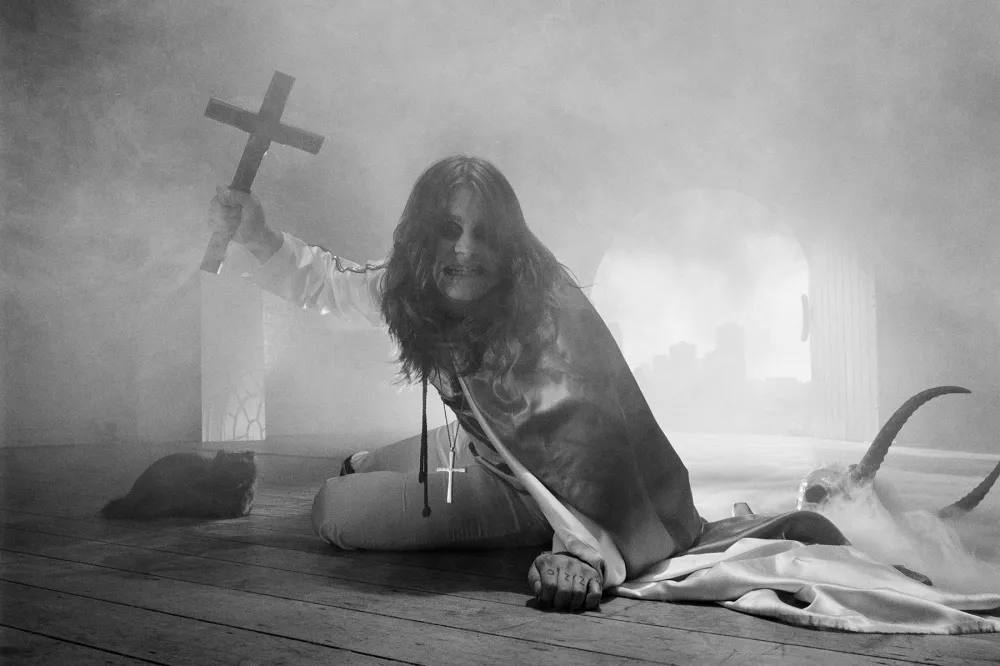
Although the court eventually rejected this claim and dismissed the plaintiff's case on May 6, 1991, the most noteworthy aspect of this case is not the final verdict, but why it happened in the first place.
What was truly put on trial was not just a song, but an ancient and persistent social impulse: when society faces youth death, mental breakdown, violence, loss of control, and inexplicable suffering, it always needs to find an object that can be named, blamed, and judged.
In the 1980s in America, music was particularly suited to play this role. It was abstract enough to be difficult to refute word by word; it was private, entering teenagers' bedrooms, headphones, bodies, and emotions; and it was public enough to be described as a symptom of a generation, the degeneration of a certain group, or a threat to some order.
What really deserves questioning is not 'can music actually kill,' but: why do people repeatedly want to put music on the gallows?
#Music Is More Than Sound
Looking at music itself, music is purely composed of physical principles: a series of pitches, a rhythmic pattern, a harmonic progression, a timbre. In itself, it does not commit crimes. A diminished seventh chord is not inherently evil, nor is a major scale melody inherently noble. Sound, as vibration, has no moral intent.
But music has never been merely sound.
It always appears in some social context: who performs it, who listens, who forbids it, who praises it, who commercializes it, who sacralizes it, who deems it noise, who regards it as tradition, who sees it as revolution. Music is not an abstract material floating in the air; it is a practice. It is entangled with the body, education, religion, the state, class, gender, race, media, and the market.
Thus, the question 'Does music have morality?' itself needs to be unpacked.
If a piece of music is inherently moral, then the morality of that specific music should exhibit a stability of judgment throughout history, much like a murderer is evil and deserves punishment.
But from ancient Greece to the present, can we find such stability?
I think not.
#Earliest Fears: From Plato to Augustine
Music was first moralized because it was believed to shape character.
In Book III of The Republic, Plato argues that music is part of the education of the guardians. He does not discuss which music sounds better, but which kinds of music will train suitable guardians for the city-state. Some modes are considered mournful, soft, licentious, or convivial, and thus unfit for guardians; while modes like Dorian and Phrygian are typically understood as brave and temperate, making them more appropriate for moral education.
His concern was not that a particular song preached wrong ideas, but that certain sonic habits would cultivate the wrong kind of person.
By Augustine's time, the focus shifted from governance of the city to internal self-examination. In Book X, Chapter 33 of the Confessions, Augustine speaks of church singing with great anxiety. He admits that music can support faith and move the soul toward religious content; but he also worries that he might be more attracted by the pleasure of the sound itself than by the truth being sung.
Music transformed from an external guide into an internal temptation. It does not need to reason to change a person's state. It exists above ideas, and simply by entering your ears it can make you weep, excite you, or even seduce you. Precisely because it is so effective, it is always suspect.
These two models form the foundation of the moral construction of music. They persisted for over a thousand years, into the modern era. Modern society no longer says 'wrong modes corrupt the guardians,' but rather 'rock music corrupts youth,' 'rap encourages crime,' 'heavy metal induces suicide,' 'pop music erodes sexual morality.' The ancient fear has changed its record sleeve but still plays on.
#Order and Control: Society's Self-Portrait
With the evolution of society and politics, descriptions of music took on a grander social imagination: what kind of music is healthy, popular, correct, progressive? What kind is pathological, degenerate, alienating, anti-social?
At this point, music ceased to be merely an aesthetic object; it became the auditory framework of social order.
After the 1930s, Soviet cultural governance gradually tightened, with socialist realism becoming the dominant framework. Socialist realism required art to represent "reality interpreted by political direction." Of course, reality contained pain, contradictions, poverty, fear, and failure, but art could not dwell on them. Art had to show the direction of history: socialism was growing, the people were awakening, the collective was overcoming difficulties, and the future was bright.
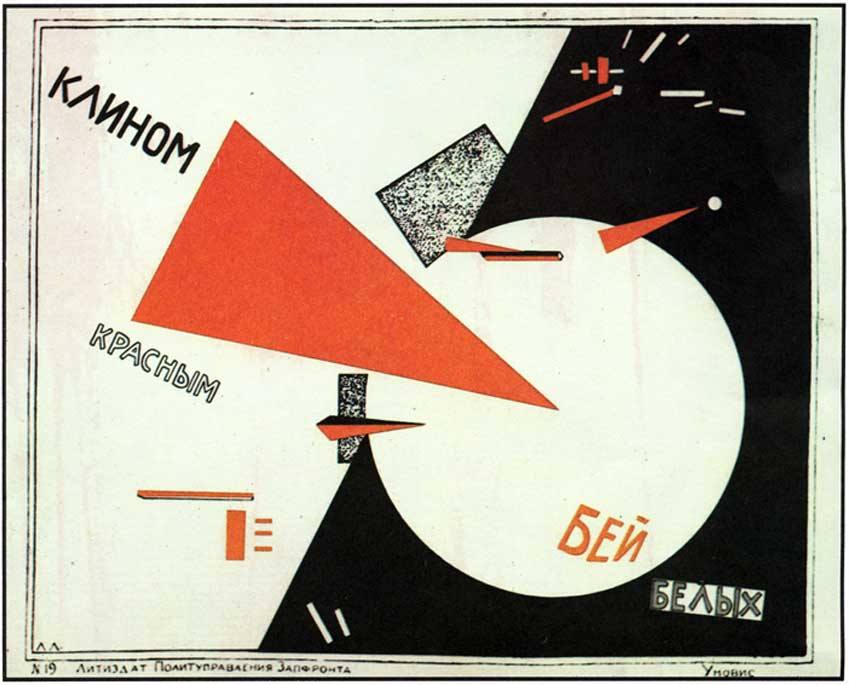
After 1946, the so-called Zhdanov line further tightened cultural purges, launching an anti-"formalism" campaign. On February 10, 1948, the Central Committee of the Communist Party of the Soviet Union issued a resolution on Muradeli's opera "The Great Friendship," which became a key point in the anti-"formalism" campaign in music. Official dissatisfaction included: the music lacked clear melodies, excessive dissonance, chaotic orchestration, failure to reflect the musical characteristics of the Caucasus peoples, and failure to inherit Russian classical opera traditions. Although the resolution targeted Muradeli, it broadly affected important composers such as Shostakovich, Prokofiev, Khachaturian, and Myaskovsky.
Nazi Germany provided another, more terrifying way of moralization.
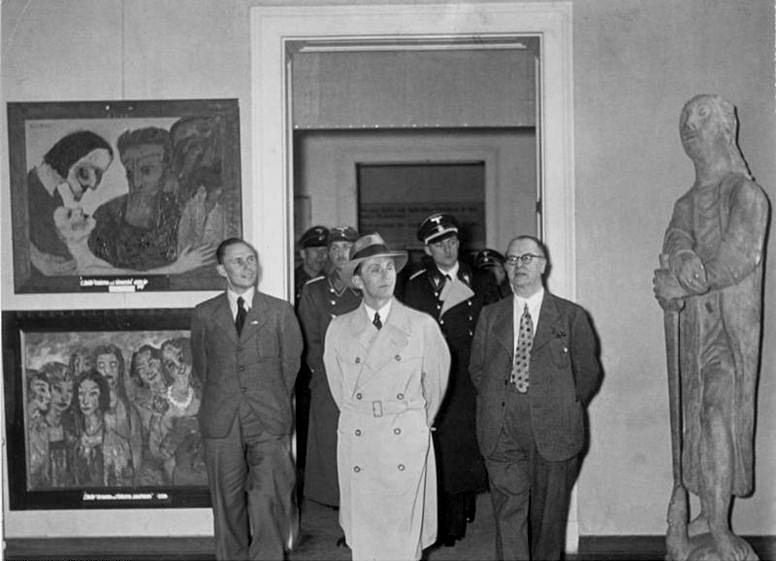
On May 24, 1938, during the Reich Music Days in Düsseldorf, the Nazis held the "Degenerate Music" exhibition. Jazz, modernism, Jewish composers, black music, and the avant-garde were bundled together as the same threat. The exhibition guide cover appropriated the image from Ernst Krenek's opera "Jonny spielt auf" and replaced the carnation on the collar with a Star of David. This visual gesture was highly revealing: blacks, Jews, jazz, modernism were forcibly compressed into a single symbol of "polluting German culture."
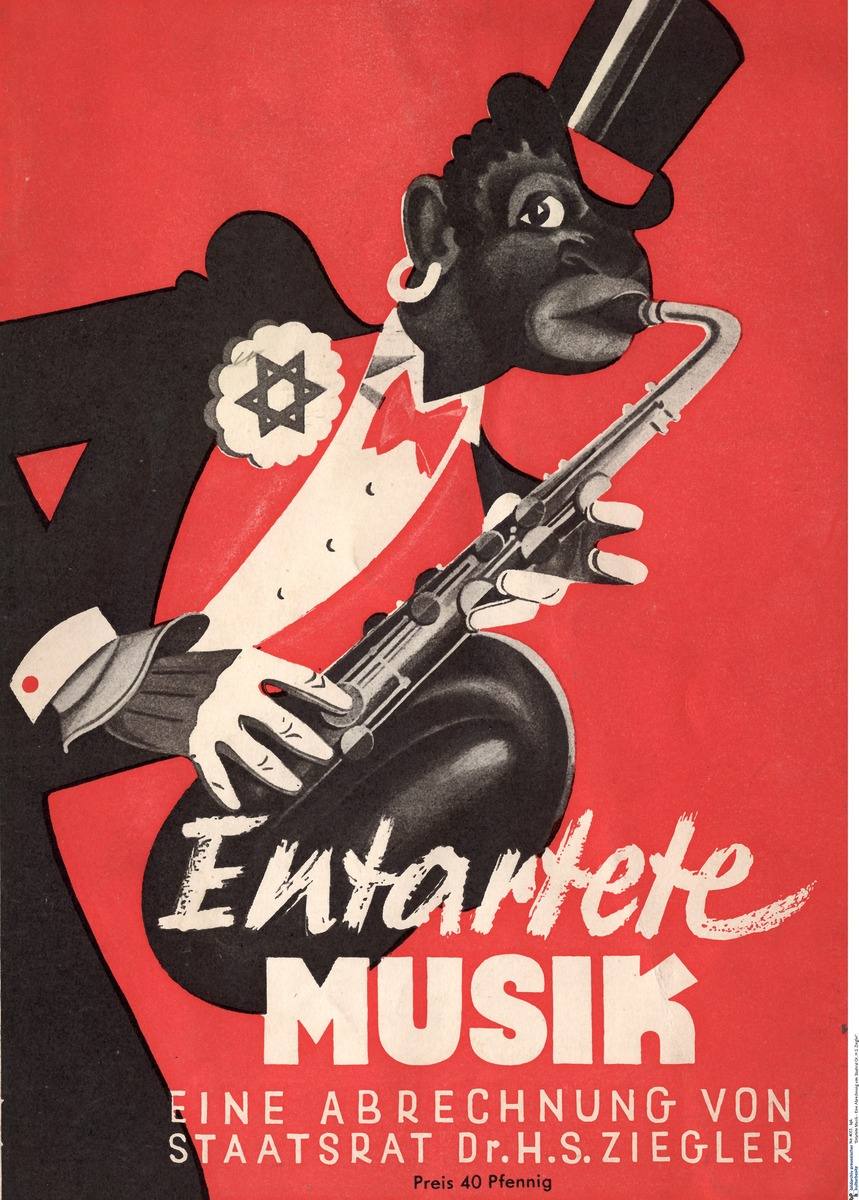
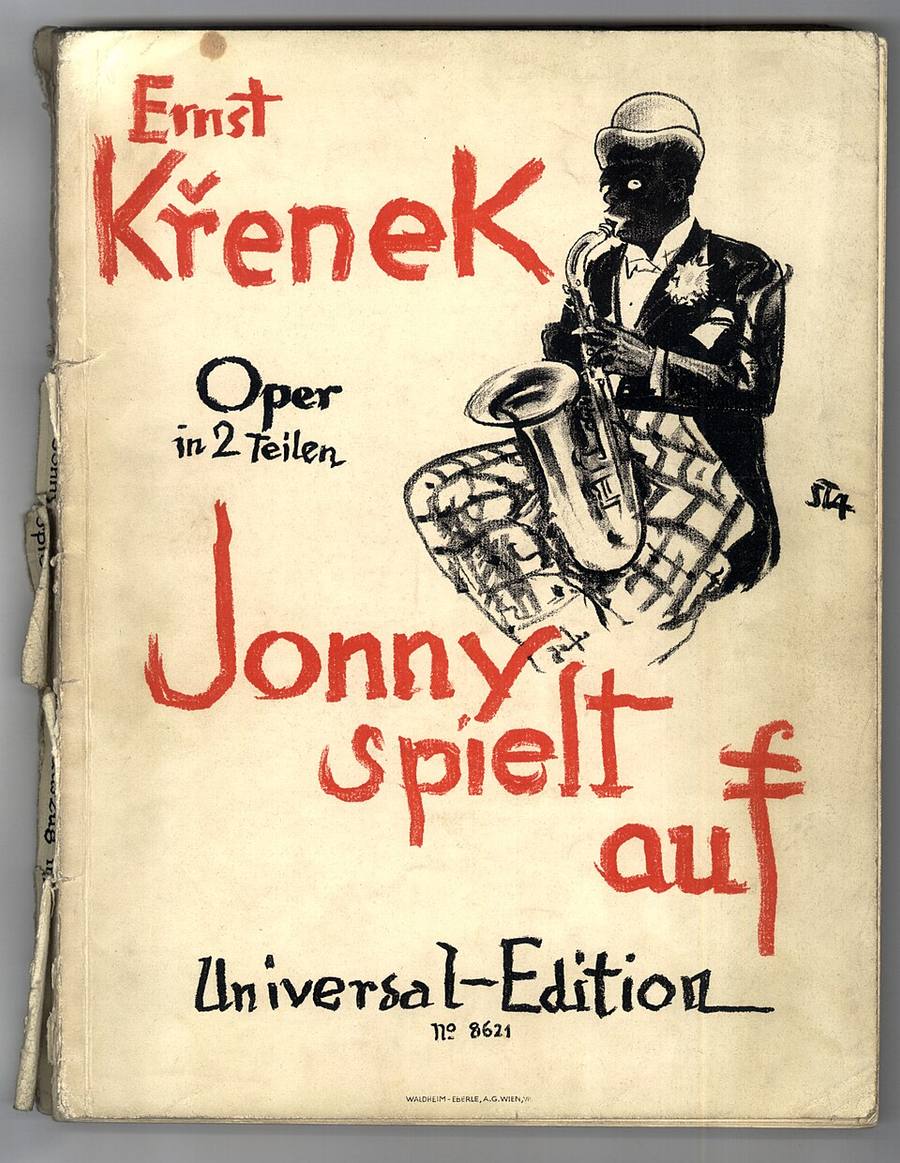
In the Nazi narrative, so-called 'degenerate music' was not about aesthetic decline but an auditory destruction of communal hygiene. Atonality, jazz, and modernism were dangerous not just because they were 'unpleasant to the ear,' but because they were depicted as foreign objects and viruses within the national body.
This is structurally isomorphic to Nazi anti-Semitic logic. It first names difference as 'degeneration,' 'pollution,' or 'pathology,' then transforms this naming into a justification for communal defense. The target could be Jews, music, art, or any non-conforming cultural form. The Nazis demanded that music submit to pure bloodlines, turning music into a hygiene science for guarding communal health.
Adorno's appearance almost turned this judgment on its head.
For Adorno, music that was too harmonious, too smooth, too easy to consume was actually suspicious. Because if reality itself has been torn apart by commodity logic, social alienation, and power structures, then truly honest music should not necessarily present a stable harmony. Fractures, dissonance, abruptness, and difficulty to consume actually reveal a false reality.
Dissonance is not degeneration; rather, it is truth appearing in negative form.
The sounds are still the same sounds, but good and evil are completely reversed. From this, it can be seen that what truly possesses moral direction is often not the sounds themselves, but the people who interpret them; it is not the chords that take sides, but society first decides what kind of world it needs, then turns around and demands that music testify for it.
#Who to Blame? Blame the Music!
Since the era of mass media, music has increasingly become the object of moral panic.
Music spreads quickly, ties deeply to youth culture, and rapidly creates generational divides. It acts directly on the body and emotions, with weak semantics—unlike written arguments that can be refuted sentence by sentence. More importantly, music often connects with society's most intractable issues: sex, class, race, rebellion, violence, addiction, psychological crisis, and family breakdown.
Thus, almost every era reinvents a kind of "dangerous music."
Jazz was once dangerous, rock was once dangerous, heavy metal was once dangerous, rap was once dangerous, punk was once dangerous. The stigmatization is not just about the melody or lyrics themselves, but their association with certain social anxieties. Jazz is not just music; it is heard as racial mixing, bodily indulgence, urban disorder. Rock is not just music; it is heard as teenage rebellion, sexual liberation, and the collapse of family authority. Heavy metal is not just music; it is heard as nihilism, self-destruction, near-death experiences, satanic worship, and mental crisis. Rap is not just music; it is heard as street violence, crime, police conflict, and racial unrest.
When society cannot handle its anxieties, it often seeks a scapegoat that is loud enough, visible enough, and young enough. Music fits that description perfectly.
The Parents Music Resource Center (PMRC), founded in 1985, was a landmark event in the American music moral panic of the 1980s. Its founders included Washington political figures such as Tipper Gore. The catalyst was Tipper Gore overhearing her daughter playing Prince's "Darling Nikki," shocking her with the sexual content in popular music.
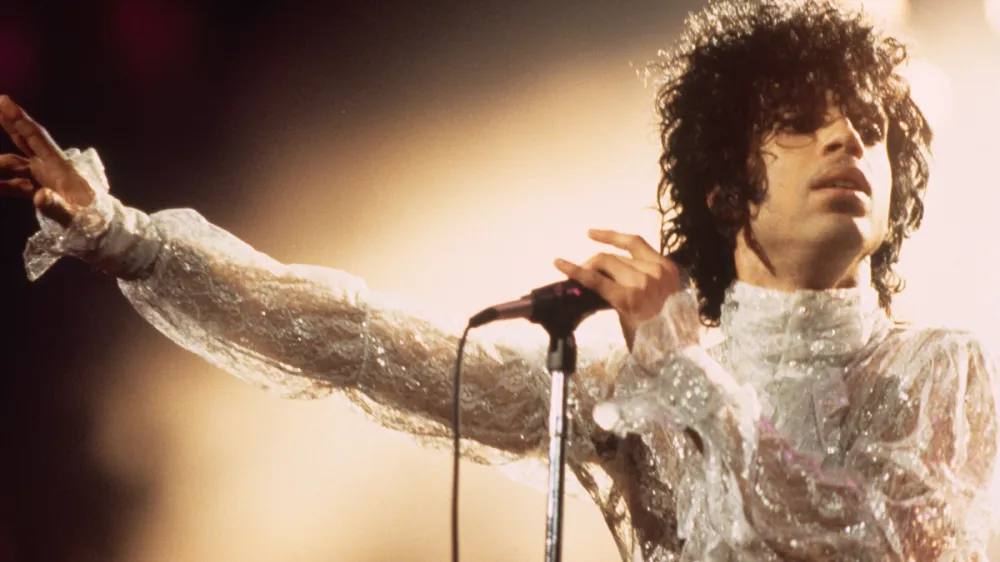
The PMRC subsequently proposed the infamous 'Filthy Fifteen' list, labeling several pop, rock, and metal songs as harmful examples. On September 19, 1985, the U.S. Senate Committee on Commerce, Science, and Transportation held hearings on record labeling. Frank Zappa, Dee Snider, John Denver, and others pushed back against this regulatory impulse during the hearings. The core debate was: Is this about protecting children, or imposing censorship pressure on art?


But under pressure from the PMRC, media controversy, and congressional hearings, the Recording Industry Association of America (RIAA) was forced to introduce the 'Parental Advisory' labeling system. Record labels could voluntarily mark music with this label to alert parents to potentially explicit content, helping them decide if the content was suitable for children.
The PMRC's real goal was not to understand music, but to translate complex cultural anxieties into manageable consumer objects. It sought not to explain why youth suffer, why families are anxious, why sex becomes a public fear, or why media changes generational relationships. Instead, when it could not control youth, sex, and media, it first controlled the packaging. When it could not explain social disorder, it first placed warning labels on sound.
Modern society hasn't abandoned Platonic fears. It has simply rewritten 'modes corrupt the city-state' as 'records will kill the youth.'
#When Moral Explanations Approach the Heart of Music
Up to this point, we have mostly discussed the social position of music: how the state regulates music, how parents fear music, how courts judge music, how ideology exploits music.
Can moral interpretation enter the internal structure of music?
An important contribution of feminist musicology is that it shattered the 'myth of pure form.' It does not simply claim that 'certain chords are guilty,' but forces musicology to admit that music is not entirely separate from the body, gender, history, and power.
Who is canonical, who is excluded; who is qualified to compose, who can only perform; what kind of music is called serious, what kind is called frivolous; which bodies are permitted to be geniuses, and which bodies can only be material.
Susan McClary is one of the most famous and controversial figures in this line of thought. She advanced gender-related discussions into the interior of music. Formal structures, harmonic resolution, melodic progression, and thematic recapitulation could all be interpreted by her as narratives of gender order.
In her analysis, sonata form is no longer just an abstract structure. The contrast in strength between the primary and secondary themes, and the forceful return of the recapitulation, can be understood as a gendered narrative: the primary theme is more vigorous, while the secondary theme is more gentle, and people see this as a metaphor for gender; because the secondary theme is often resolved in the recapitulation, shifting from a subordinate key to the tonic, it is considered a form of oppression of women. Her discussion of the violent recapitulation in the first movement of Beethoven's Ninth Symphony is one of the points of controversy.
Humans cannot help but project power, desire, and morality even into the most abstract forms.
And McClary is not the end.
If we push the depth of 'music being interpreted through power' further inward, we will see several layers.
The first layer concerns musical institutions and canons: who is included in music history, who is excluded, who is called a master, and who is deemed marginal.
The second layer involves narrative and formal structures: sonata form, climax, cadence, tension and resolution are read as enactments of social relations.
The third layer is tonality, harmony, and the mechanism of desire: not just the structure of the work, but how the operation of tonality itself organizes expectation, delay, fulfillment, and belonging.
The fourth layer is the racialization of timbre and voice, where even 'what kind of person does this sound belong to' becomes a question of power.
It seems that humans find it difficult to treat music merely as sound.
#When we talk about music, what are we really talking about?
Now we can return to the original question: Does music have morality?
If 'music' refers to abstract material, then it does not possess fixed, stable, or universally applicable moral attributes. A chord itself does not commit a crime, a rhythmic pattern itself does not degenerate, a timbre itself does not betray a community. Music is not a container of inherent good or evil.
But if 'music' refers to music in society—music that is performed, disseminated, consumed, prohibited, educated, stigmatized, institutionalized, and commercialized—then it is inevitably entangled in moral judgment. Music can serve national narratives, construct community boundaries, bear religious piety, induce bodily pleasure, create generational conflict, become a market commodity, be used to exclude others, and also become a voice of resistance.
What is truly worth criticizing is usually not music itself, but how people use music to exclude others, beautify power, manage thoughts, and amplify moral panics.
This is precisely where the 'failure to be self-consistent' lies.
On the surface, people are discussing music; in reality, they are using music to discuss what they fear, what they want, and what they are prepared to exclude.
#Who exactly is being sent to the gallows?
From Plato's selection of modes to Augustine's suspicion of sensory pleasure; from the Soviet Union's opposition to 'formalism' to the Nazis' creation of 'degenerate music'; from Adorno's defense of dissonance to the PMRC's warning labels on records; from Waller v. Osbourne trying to hold a song responsible for death to feminist musicology incorporating form, timbre, and theoretical systems into power analysis—humans have repeatedly done the same thing: using music to talk about what unsettles them most.
The desires, fears, and loss of control that society cannot handle have together created a 'hat factory' belonging to music.