Listening, Music in Silence
If a tree falls in a forest and no one is around to hear it, does it make a sound? From Schulhoff's silent score, Cage's 4'33", Duchamp's Fountain to Rauschenberg's White Paintings—exploring the boundaries of music and how silence becomes the loudest listening.
If a tree falls in a forest and no one is around to hear it, does it make a sound?
This is a classic question about perception and existence. Does something that is not perceived equate to non-existence? And is everything we perceive the entirety of the world? It is too big and too difficult, so it is often left to philosophy.
But in music, this question suddenly becomes concrete.
Music is always composed of sound, which is ultimately just vibration. The vibration of air, the vibration of a tree trunk breaking, the vibration of leaves rubbing – they can all be recorded by instruments. But are they music?
Obviously not.
Although music is composed of sound, it is not equal to sound itself. Just as clay is not porcelain, sound is not music. Melody, rhythm, harmony, and timbre—like a set of intricate architectural structures—cut, arrange, and decorate flowing time, finally organizing it into the 'works' we know. However, with the advent of the industrial age, this vast architecture was easily packed into vinyl records and radio stations by recording technology, which drained the sacredness of music, turning it into an infinitely reproducible cheap commodity.
Thus, creation is like a besieged city. Continuing with 'addition' seems to have no way out. So where exactly are the boundaries of music? Some composers turned to more extreme 'subtraction' strategies: since sound has been nearly exhausted, simply peel away sound layer by layer, forcibly restarting hearing.
But after sound disappears, is there still some invisible framework that supports music continuing to exist?
#The Manifestation of Silence
The ambition of modern music lies precisely here. It constantly collides with the boundaries of music, not to destroy, but to force out the long-hidden skeleton.
But in the face of modern music, the most genuine reaction of the public is often not a thoughtful critique, but a discomfort and a sense of being deceived.
“This is not music at all, it’s just noise!”
This reaction is not wrong. It precisely captures the core of the issue. What is truly unsettling is never 'ugliness,' but the collapse of boundaries. The traditions of meticulous training, arduous composition, and rigorous performance seem to lose their foundation and meaning in an instant, leaving only silence.
Relative Silence
In 1919, Czech composer Erwin Schulhoff wrote In futurum, a piano piece that almost produces no sound. The score contains countless rests, time signatures, expression marks, and performance instructions, even arrangements such as 'the left hand plays the high part, the right hand plays the low part.' Schulhoff almost 'overused' traditional notation in an exaggerated way, turning silence itself into a writable musical material, and through this precision, gave it a Dadaist theatrical effect.
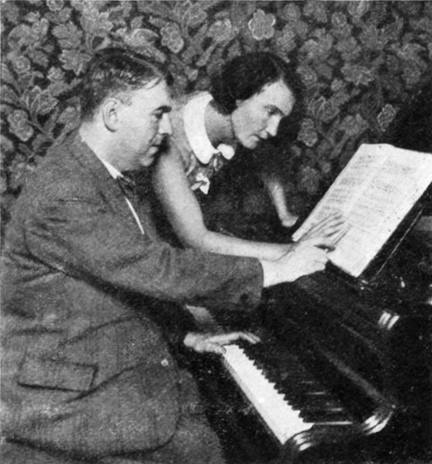
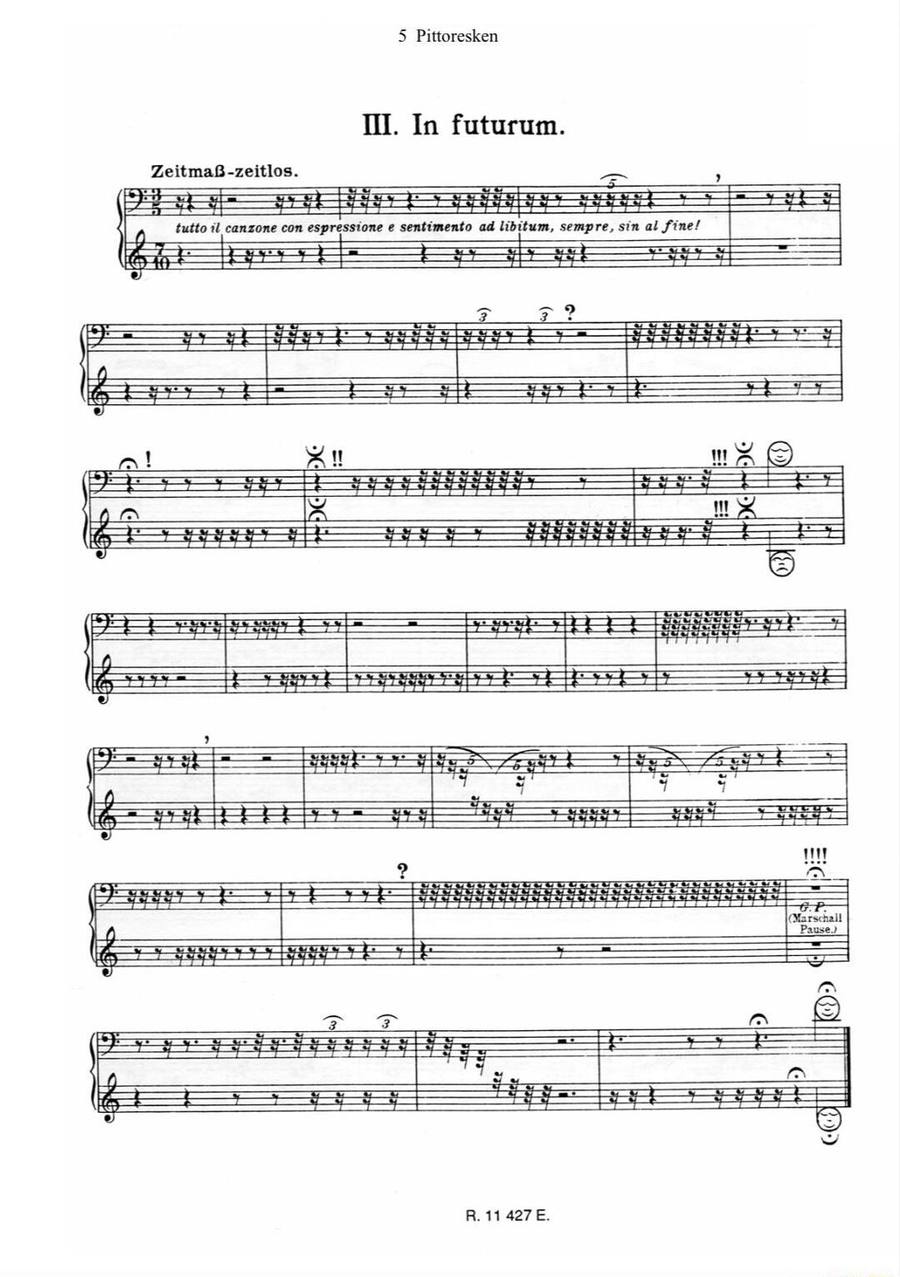
The performance is like an absurd ritual. The performer sits at the piano, following the score’s instructions, but produces no actual sound. The whole affair appears serious, complete, even solemn, yet the air contains almost nothing. The piece’s duration is also not fixed; it depends on how the performer handles these silences, or rather, on how far they are willing to take this ritual.
It at least proves one thing: silence can be written, and it can be listened to.
Silence is no longer just a blank space outside music; it can become a material in the composer’s hands, with duration, structure, and expression. But this is not a boundary, because Schulhoff did not let music lose control. No matter how absurd 'In Futurum' sounds (or looks), the score is still fixed, and the performance still follows traditional demands for accuracy. Those silences, in the final analysis, are still the composer’s control and monopoly over chance, still subject to his will.
In 1919, silence could enter music, but it was still confined to the score.
Absolute Chance
In 1948, John Cage had already conceived the idea of creating a completely silent piece. He called it 'Silent Prayer'.
[I intend] to compose a piece of uninterrupted silence and sell it to Muzak Co. It will be 3 or 4½ minutes long—those being the standard lengths of “canned” music—and its title will be Silent Prayer. It will open with a single idea which I will attempt to make as seductive as the color and shape and fragrance of a flower. The ending will approach imperceptibility.
I intend to compose a piece of uninterrupted silent music and sell it to Muzak background music company. This piece will last 3 minutes or 4 and a half minutes—these are the standard lengths of 'canned music'—and the title will be 'Silent Prayer'. It will start with a single idea, and I will try to make that idea as seductive as the color, shape, and fragrance of a flower. And its ending will gradually approach nothingness until it is imperceptible.
From this passage, it's clear that 'Silent Prayer' was more of a spiritual, anti-commercial idea. At that time, he envisioned writing a 3-to-4.5-minute 'continuous silence' to sell to Muzak, inserting it into malls, elevators, and public spaces as an ironic pause to 'canned music.'
But at that time, it was just an idea. Cage had not yet found a powerful enough way to make 'silence' truly work as a public musical work.
Until early 1951, he was still trapped to some extent in the cage of a score that breaks conventions with conventions. That year, he attempted to introduce chance into 'Music of Changes' using the I Ching. This was already a challenge to traditional compositional authority, but upon closer inspection, it was still a kind of chance domesticated by the composer. Chance occurred at the desk, during the process of generating material; once it was written into the score, the performer still had to execute it precisely.
But it was also in that year that things changed.
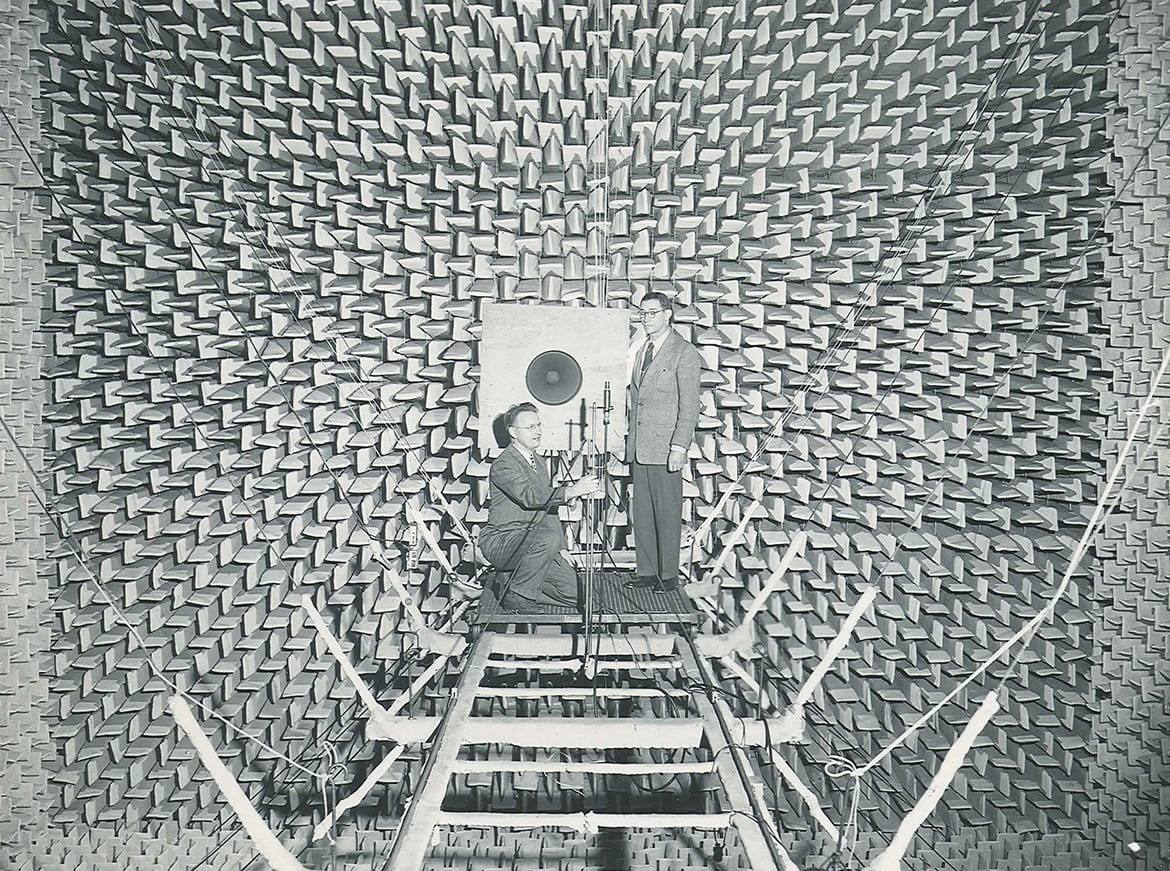
Cage visited the anechoic chamber at Harvard University. He thought he would experience absolute silence there, but instead he heard two sounds: a high-pitched one, which was his nervous system working, and a low-pitched one, which was the circulation inside his body. At that moment, he realized that silence is not the opposite of sound. What we call silence is nothing but sounds we usually don't notice. These sounds could also become 'intentional sounds' and material for musical composition.
But the material was not enough; he still needed a framework.
Also in 1951, Robert Rauschenberg created the White Paintings.
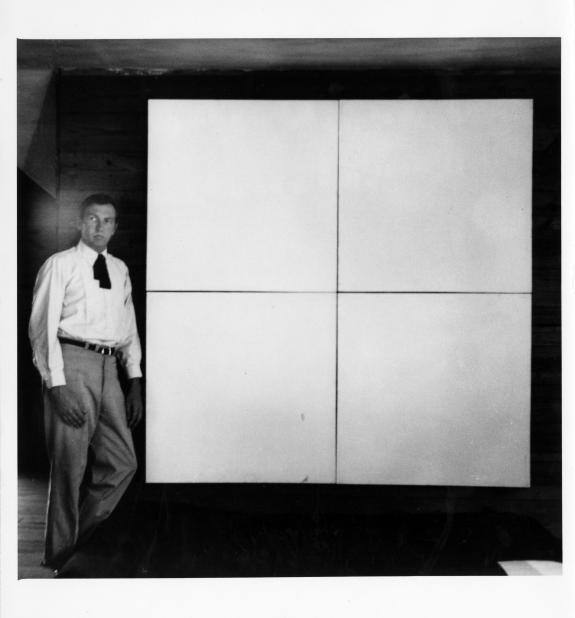
These were a series of modular canvases, painted entirely white. They didn't display images but instead reflected the variations of light, shadow, and dust in the surrounding space. When Cage saw them, he almost immediately understood their significance.
To whom it may concern. The white paintings came first; my silent piece came later.
To whom it may concern: The white paintings came first; my silent piece came later.
Cage did not see the White Paintings as empty voids of 'nothingness'; instead, he described them as 'airports for the lights, shadows, and particles.' The canvas itself no longer output any subjective intention of the artist, but became a sensitive receiver, capturing changes in the room's lighting, the shadows cast by passing viewers, and even the dust floating in the air.
The White Paintings gave Cage a decisive inspiration: if painting could cease to depict objects and simply allow the environment to manifest, then why couldn't music cease to produce musical tones and simply allow sounds to appear? The White Paintings provided the courage to move from 'conception' to 'execution' for the Silent Prayer.
Thus, in 1952, 4′33″ was born.
It premiered on August 29, 1952, at the Maverick Concert Hall in Woodstock, New York, performed by pianist David Tudor. The performer sat at the piano and, over three movements, played no intentionally produced sounds. The most crucial instruction in the score was 'TACET' — silence.
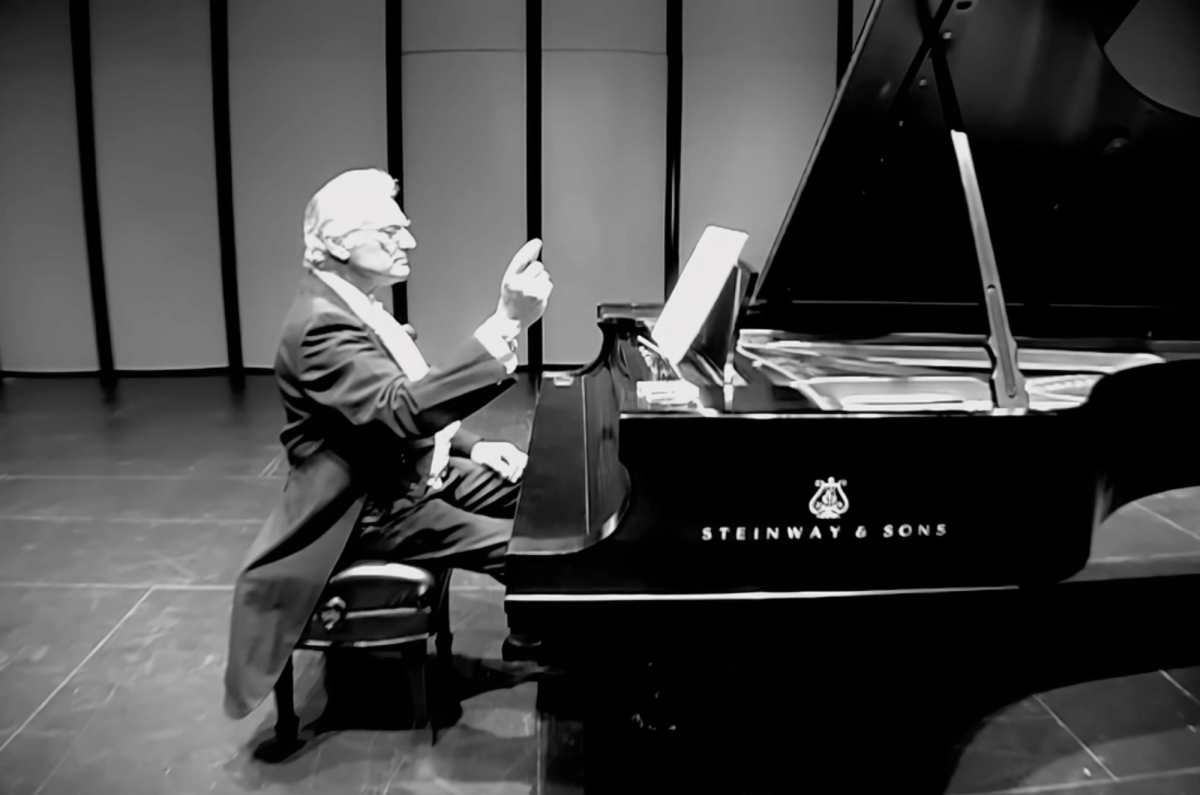
4'33" is the musical equivalent of the "white painting." It provides a temporal frame (a canvas) to hold the environmental sounds (light and dust) that we usually ignore.
Within the prescribed time frame, the composer offers none of the expected musical tones. So rain, wind, audience coughs, scraping chairs, and impatient rustling all flood into the work. They are not decoration, not interference, not background noise. They become the performance itself. Cage later recalled: in the first movement, you could hear the wind outside; in the second, rain began to beat on the roof; by the third, people were producing all kinds of interesting sounds themselves, talking, leaving their seats.
Schulhoff wrote about "controlled silence." Cage opened up "true chance."
Framing
But none of this answers our original question: why are these sounds just noise on the street, yet become a work in the concert hall?
Duchamp's Fountain provided an advance theoretical framing for 4'33".
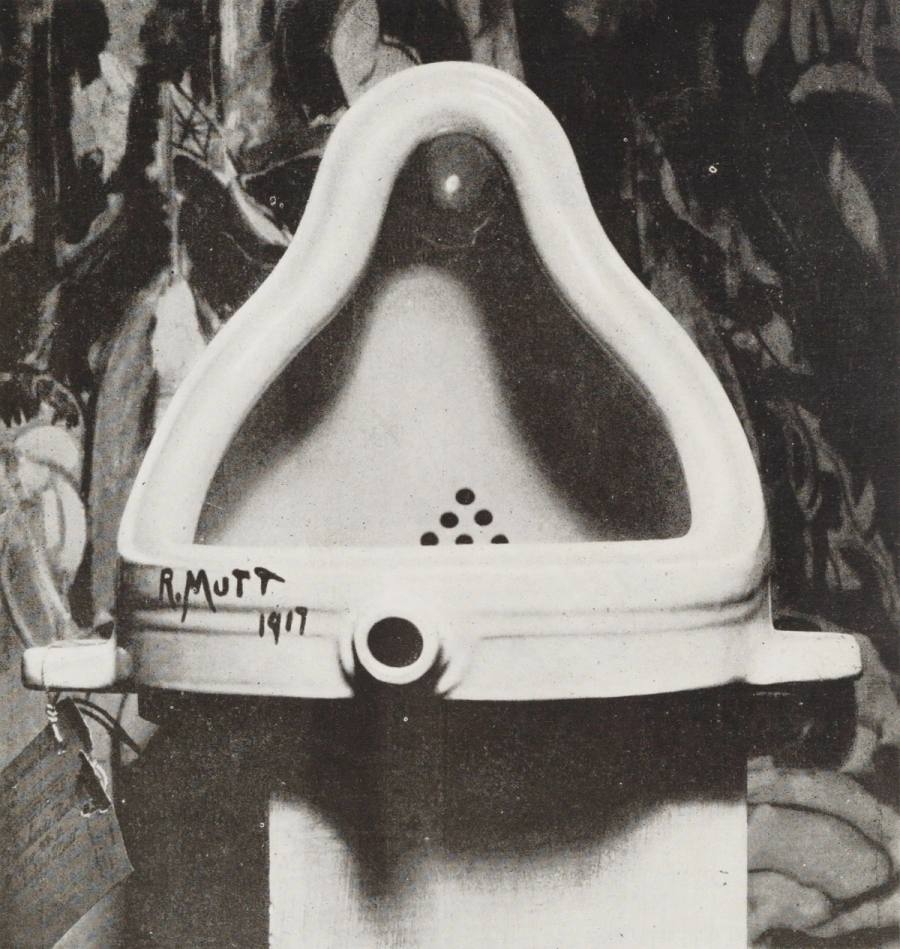
In 1917, Duchamp turned an ordinary urinal upside down, signed it, and submitted it to an art exhibition. Its shock did not come from being 'beautiful,' but from forcing people to recognize that art exists not only in the object itself, but also in naming, choosing, placing, exhibiting institutions, and ways of viewing.
A urinal entered the art museum not because ceramic suddenly became noble, but because it was placed within a different framework of meaning.
The same is true of 4'33". Cage did not betray the musical institution. On the contrary, he used it extremely cleverly.
Without a concert hall, without an audience buying tickets and entering, without a pianist sitting at the center of the stage, without movement structures, without timing, without the notation 'TACET,' those four and a half minutes would likely have been just an awkward blank. Precisely because it borrowed all the rituals of a concert, the audience listened with the attention of hearing a symphony to sounds that are usually pushed into the background.
He did not give you sound, but gave you a framework in which you must listen.
4'33" made the boundary of music clearly visible for the first time; time (duration) became the sole container of music, not pitch. After it, the definition of music was completely rewritten: any sound, as long as it is given the focus of listening within a specific time frame, can become music.
But new questions followed: if music must rely on institutional frameworks like concert halls, scores, pianos, and movements, is it ultimately just a conceptual game within Western modern art?
#Shattering Time
From Schulhoff to Cage, silence was always placed in some kind of container.
Schulhoff wrote silence as notes. Cage placed silence in time. Whether 33 seconds, 2 minutes 40 seconds, 1 minute 20 seconds, or other versions of the piece's duration, 4'33" still has a beginning, an end, and a finale. Silence was liberated, but it was still dancing with the shackles of time.
La Monte Young decided to shatter those shackles as well.
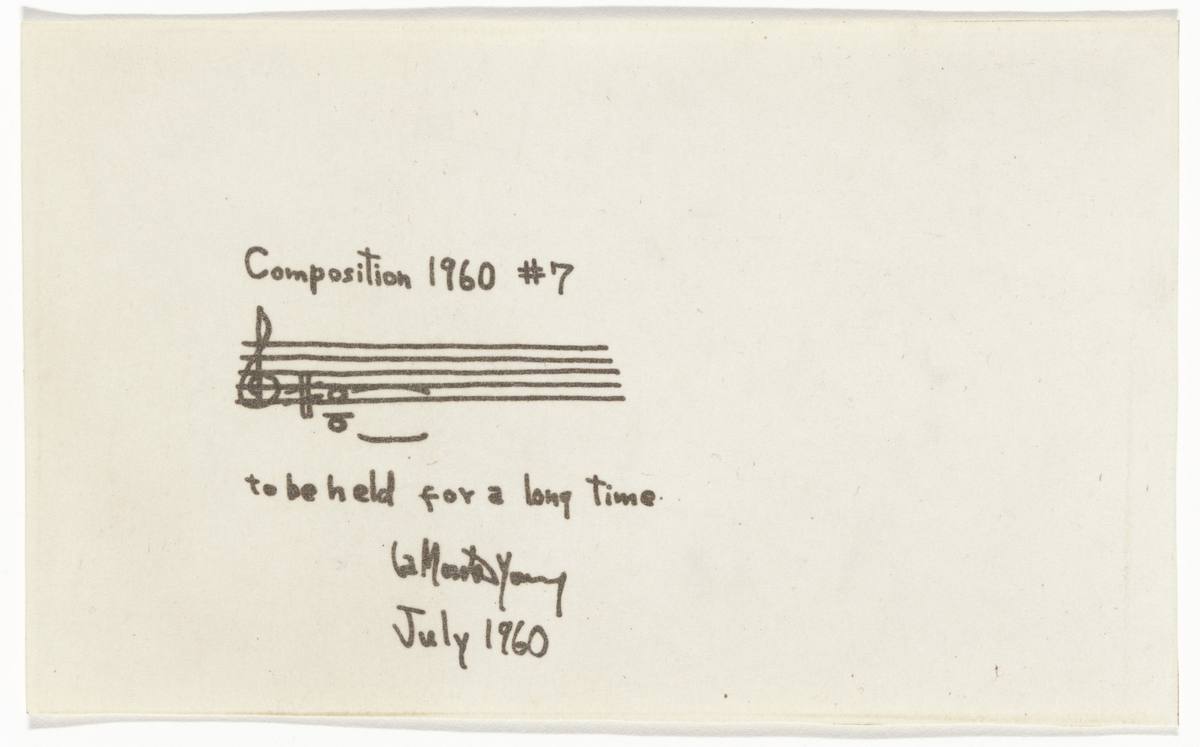
La Monte Young's 1960 Composition 1960 #7 is almost like a stern command: two notes, B and F#, form a perfect fifth, and are then required to be 'held for a very long time'. If you watch its live performance, the most striking aspect is precisely that almost nothing 'happens': an interval is continuously extended, suspended, sustained, for so long that it no longer resembles a melody, no longer an event, no longer even a piece, but begins to become a spatial state. Sound no longer leads you to the next phrase; it keeps you in place, forcing you to enter its interior.
In projects like Dream House, this logic is pushed further: sound can last for years. Music no longer begins, develops, and ends like a performance, but becomes like a room, a climate, an inhabitable physical space.
Cage made us aware that silence always contains sound. La Monte Young made us aware that sound itself can also cease to obey narrative. It can have no climax, no resolution, no 'next phrase'. It does not progress through time, but unfolds in space.
At this point, we finally approach a deeper question: perhaps the boundaries of music have never been solely a matter of art, but rather a matter of perception itself.
The biologist Jakob von Uexküll proposed a concept: Umwelt, usually translated as 'environmental world.' It means that every living being does not live directly in the same 'objective world,' but rather in the world allowed by its own perceptual abilities.
Bats live in a world of echolocation. Dogs live in a world of extremely rich olfactory layers. Humans live in their own limited visual, auditory, and linguistic order. We think we all share the same world, but in fact each species peeks at the universe through different cracks.
What is silence, then?
Silence is merely a human assumption of 'no sound,' and this explains the unease that silent music brings to people. It doesn't create anything real; it merely forces you to realize that you have been listening in a certain way, but silence can also be listened to.
#Umwelt: Another Kind of Singing
When we stop singing, we will be finished
When we stop singing, we will be finished
This is what an elder of the Suya community said. In Suya society, singing is not merely an aesthetic object. It organizes labor, convenes rituals, expresses identity, preserves cosmology, and shapes the community. Music is not a work hung on the wall of an art gallery, but a part of people's order of life.
Some say that when we sing, we are fed. Others say that when we sing, we grow strong. Still others say that when we sing, we become ecstatic.
This forces us to reexamine 4'33". People often believe that singing and dancing can strengthen cultural identity by uniting participants around an activity, but scholars rarely recognize that the sound of music itself is part of this process. Cage reduced sound to near zero, allowing us to hear how the environment intrudes into music. The Suya people, through singing, directly create community. One moves toward silence, the other toward collective voice. Opposite directions, yet together they prove that music is far more than an arrangement of pleasant sound waves.
#Listen: The Music in Silence
So, is 4'33" music or not?
This question has long been meaningless; it forces us to choose between "yes" and "no," flattening all the real complexity in between.
When White Painting was exhibited at the Stable Gallery in 1953, Cage wrote a comment for it:
To whom: no subject, no image, no taste, no object, no beauty, no message, no talent, no technique, no why, no idea, no intention, no art, no object, no feeling, no black, no white, no and.
To everyone: no subject, no image, no taste, no object, no beauty, no message, no talent, no technique, no reason, no idea, no intention, no art, no object, no feeling, no black, no white, no and.
A more worthwhile question is: when we say "music," what exactly are we acknowledging?
Duchamp once said of modern art:
If he chose artworks that exist solely for their beauty, he would fall into the same pattern as those who pick up driftwood on the beach. He also chose these artworks for their beauty, and thus they become pure aesthetic objects, like sculptures and such. But he wanted his work to escape this constraint. The problem, however, is that people have become accustomed to viewing artworks as a means of pursuing beauty.
The boundary of music is also the boundary between 'utility' and 'art.' Silence is more like a scalpel. It cuts through the epidermis of habit, cutting through our dependence on melody, notes, compositions, and artists. Then we see that music is not always hidden within sound. Often, it is hidden in the moment of how we wait, how we pay attention, how we acknowledge that certain sounds are worth hearing.
Listen,
Music in silence.